


Table of Contents
- 1 What Are Classified Listings?
- 2 What Are Directory Listings?
- 3 Directory vs Classified Listings: Side-by-Side Comparison
- 4 The Key Differences That Actually Matter
- 5 Which Should You Build? A Simple Decision Guide
- 6 How to Build Either Type with Directorist
- 7 Frequently Asked Questions
- 7.1 Is a business directory the same as classified ads?
- 7.2 Which is better for SEO, a directory or a classified site?
- 7.3 Can I build both a directory and a classified site on WordPress?
- 7.4 What are examples of directory vs classified sites?
- 7.5 How do directory and classified sites make money?
- 7.6 Which model is cheaper to start?
- 8 Final Thoughts
Directory vs Classified Listings: Which Should You Build?
-

- Classifieds Listing
- 9 mins read
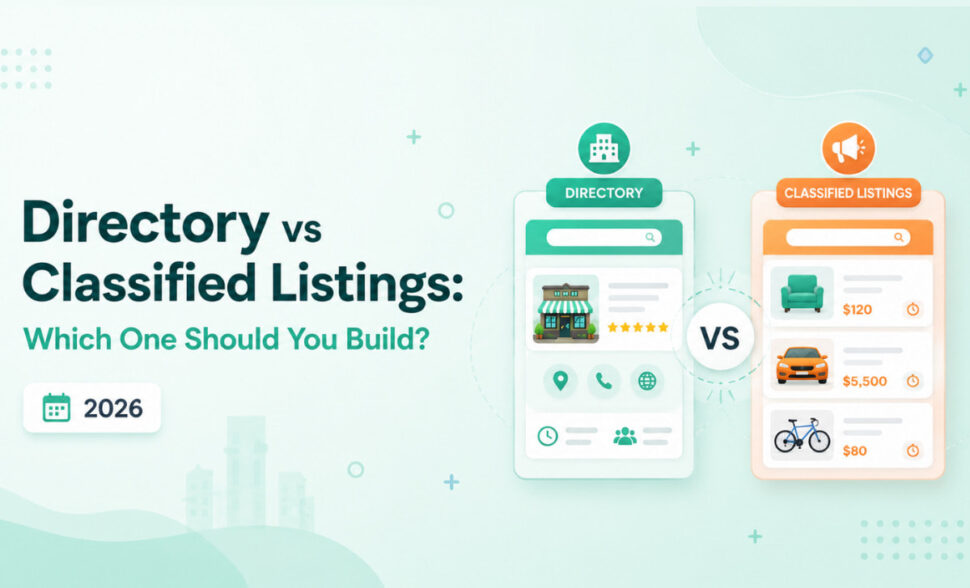
Choosing between a classified directory and a business directory is a real decision with real consequences for how you build, how you charge, and how you grow. Here is the short answer: a business directory listing is a permanent, searchable profile for a company or service, built for long-term discovery. A classified listing is a short-term ad posted to complete one transaction – a sale, a rental, a hire – and then it’s gone.
Both involve listings. Both let users search and browse. But the logic underneath each model is different, and picking the wrong one means building the wrong site. This guide explains the real differences between the two, helps you decide which fits your goal, and shows you how to build either one on WordPress.
What Are Classified Listings?
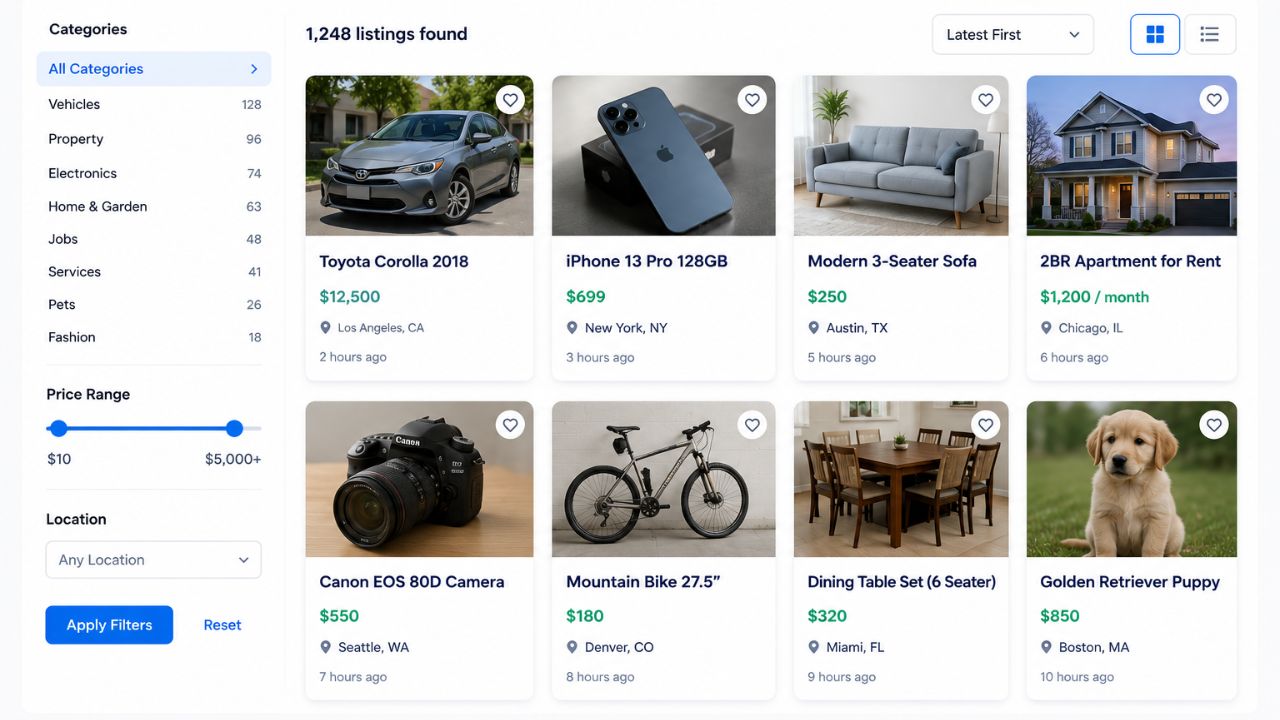
A classified listing is an ad. Someone wants to sell a sofa, rent a parking space, hire a gardener, or fill a position. They post a short notice with a title, a description, a price, and their contact details. A buyer finds it, gets in touch, and the deal happens. The listing then expires or gets removed.
The most recognized platforms are Craigslist (North America), Gumtree (UK and Australia), and OLX (Asia, Africa, and Latin America). What all three share is low friction to post, a simple listing format, and a hands-off relationship between the platform and the transaction. The platform provides the space; the users handle everything else.
Classified listings work because of volume and speed. The more active ads on a site, the more useful that site becomes. A single highly detailed profile matters less than having a large, constantly refreshed inventory of ads.
What classified listings are good at:
- Getting users to post without friction – minimal fields, often no account required
- Driving transactional intent – visitors arrive ready to buy, hire, or rent
- Generating revenue through per-listing fees, featured ad slots, and display advertising
- Building listing inventory quickly because posting takes under two minutes
Who should build a classified site: Entrepreneurs building a local marketplace, a second-hand goods exchange, a regional jobs board, a peer-to-peer rental platform, or a gigs-and-services section.
What Are Directory Listings?
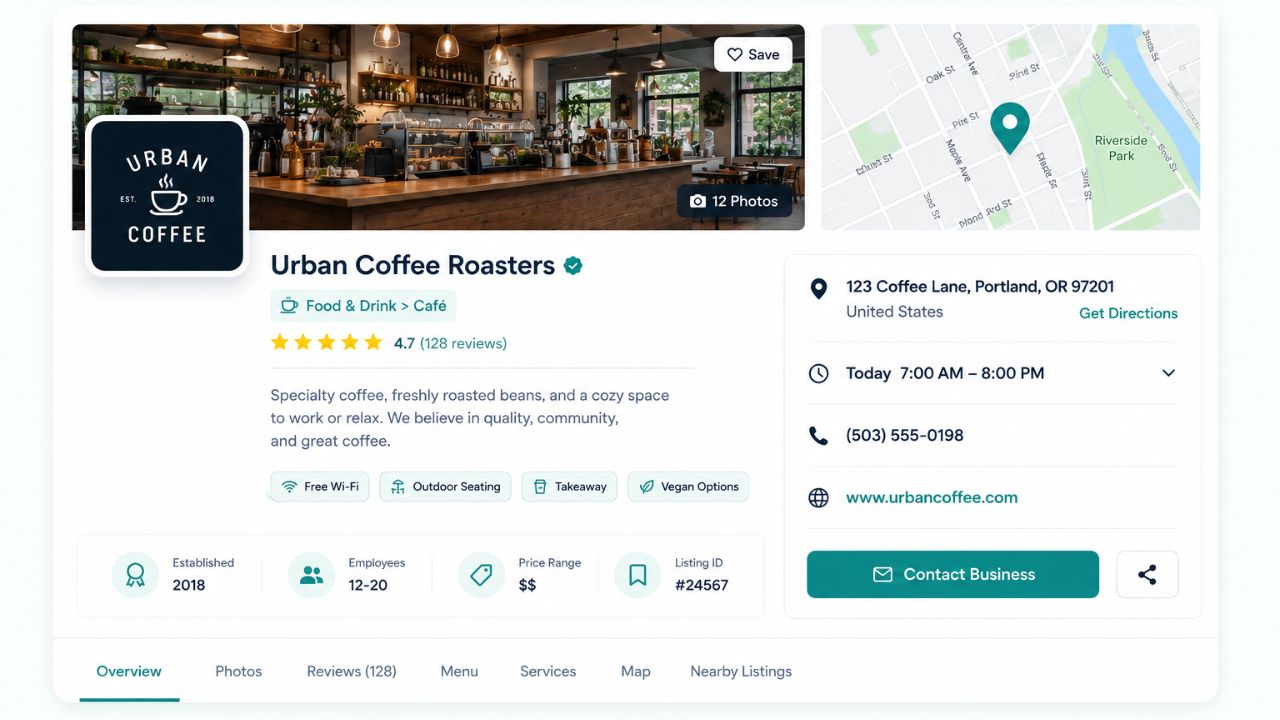
A directory listing is a structured profile for a business, service, or professional. It is designed to stay live indefinitely and to help users find, compare, and evaluate their options – this is the core business directory definition.
Yelp lists local businesses with photos and reviews. Google Business Profile lets any business appear in local search with hours, contact details, and a map pin. TripAdvisor catalogs hotels and restaurants with detailed ratings from past visitors. These are directories. A listing on these platforms builds credibility over time. Users return to them not just to find something once, but whenever they need that type of service again.
The listing itself is richer: business name, address, phone, website, categories, images, hours, and a review section. The depth of the profile is the point. A business with a complete, reviewed directory profile becomes easier to trust for someone who has never visited before – this is what separates business listing sites from simple ad boards.
What directory listings are good at:
- Helping users compare options before they commit – reviews, ratings, and search filters carry the weight
- Generating recurring revenue – businesses pay monthly or annually to stay listed, not just to post once
- Building evergreen SEO value – permanent listings accumulate structured content and local search authority
- Creating a trusted reference that users return to regularly, not just once
Who should build a directory site: Anyone building a niche business finder, a professional network, a curated vendor list, a city guide, or an industry-specific resource.
Directory vs Classified Listings: Side-by-Side Comparison
Here is a direct comparison across the dimensions that matter when deciding which type of site to build.
| Feature | Classified Listings | Directory Listings |
|---|---|---|
| Main purpose | Connect buyers and sellers for a specific transaction | Help users find and evaluate businesses or services |
| Structure | Individual ads grouped by category | Detailed business profiles organized by type and location |
| Listing lifespan | Time-bound — typically 30 to 90 days, then expired | Evergreen — renewed by subscription or maintained long-term |
| Real-world examples | Craigslist, Gumtree, OLX, Kijiji, Facebook Marketplace | Yelp, Google Business Profile, TripAdvisor, Yellow Pages, Angi |
| User interaction | Buyer contacts seller directly; platform does not mediate | User searches, reads reviews, compares options, then contacts |
| Monetization models | Per-listing fee, featured ad slots, display advertising | Monthly/annual subscription, claim listing upgrade, premium placement |
| Build complexity | Lower — minimal fields, simple submission form | Higher — requires custom fields, review system, map, filters |
| Best fit for | Marketplaces, local ad platforms, job boards, rental ads | Business finders, local guides, professional networks, niche directories |
The Key Differences That Actually Matter
Purpose: transactions vs discovery
On a classified site, the visitor arrives with something specific in mind. They want a used car in their city, a plumber for next week, or a graphic designer for a quick job. The platform’s job is to surface relevant ads fast and step back. On a business directory site, the visitor often comes with a broader need — “I need a good accountant” or “What is the best Italian restaurant near me?” The platform’s job is to help them evaluate options and feel confident before they contact anyone.
This single difference in user intent drives almost every other design decision on the two types of site.
Structure: thin and fast vs rich and deep
Classified ads are intentionally sparse. A title, a short description, a price, and a contact method are enough. Adding more required fields would slow down posting and reduce ad volume — and volume is the product on a classified site. Directory profiles work the opposite way. The more a listing includes (photos, hours, services, verified reviews), the more useful it is. Depth is the product.
Monetization: pay-to-post vs pay-to-stay
On a classified site, you are selling the right to post. The listing is the transaction. Charging per ad, selling featured placements, or running display ads are natural fits. On a directory site, you are selling visibility and credibility to businesses that want to be found. The business pays a recurring fee to maintain their profile. This creates a fundamentally more predictable revenue model, but it takes longer to reach critical mass because you need to sign up paying businesses, not just sell individual ad slots.
Growth and SEO
Classified sites grow through listing volume and freshness. More ads, more reasons to visit, more transactional queries to rank for. Business directory sites grow through depth and trust. More complete profiles, more honest reviews, and tighter category coverage build topical authority over time. The two growth loops are different, and so is the editorial effort required to run each site well.
Which Should You Build? A Simple Decision Guide
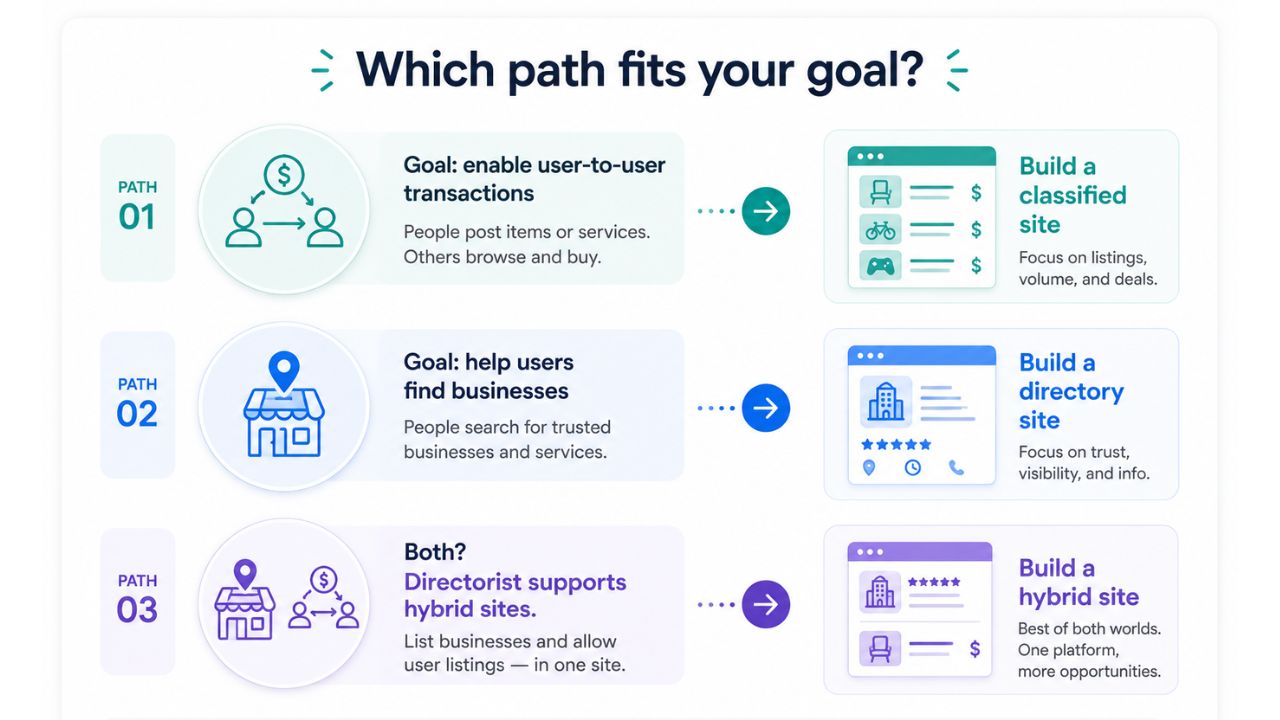
If your goal is to let people buy, sell, or trade specific items locally: build a classified site. Second-hand goods, local rentals, peer-to-peer services, and short-term job posts all fit this model. Low friction to post and a fast listing cycle match what your users need.
If your goal is to help people find and evaluate businesses or professionals: build a directory. A therapist finder, a local restaurant guide, a curated list of contractors, or a city business hub all benefit from permanent profiles, a review system, and the ability to filter by location, category, and rating.
If you are building a job board: either model works, but they optimize for different things. A classified-style job board lets employers post quickly with minimal setup, which drives listing volume and attracts candidates actively browsing. A directory-style job board lets employers build a company profile that candidates can research before applying, which tends to improve applicant quality. Many established job boards — including Indeed — use elements of both: employer profiles as directories, individual job posts as classifieds.
If you are not sure yet: start with a directory. Directories generate more predictable recurring revenue because businesses pay to stay listed rather than paying once to post. They also tend to build stronger long-term SEO because listings are permanent and accumulate content and structured data. You can add a classified section later once your audience is established.
How to Build Either Type with Directorist
Directorist is a WordPress plugin that handles both listing models. You do not need a separate plugin for each approach, and you do not need to commit to one model permanently from day one.
Building a classified site: The dClassified theme is built specifically for classified listing sites. It pairs with Directorist to give you a front end that looks and works like a classifieds platform – a grid of short ads, a simple submission form, category browsing, and search. You set listing expiry dates so ads disappear automatically when the time is up.
Charging per listing, offering featured placements, and giving users a front-end dashboard to manage their own ads are all handled through Directorist’s monetization and user role features. For a full breakdown of what it costs to get a site like this live, the guide to how much it costs to build a directory or classifieds site covers hosting, plugins, themes, and ongoing expenses without the typical optimism.
Building a business directory: The plugin includes what a directory needs out of the box: custom listing fields, location-based search with map integration, category and tag filters, a review and rating system, and a monetization layer for claim listing and subscription plans. Businesses can submit their own profiles and you control which fields are required.
A complete profile – with images, hours, service descriptions, and verified reviews – gives the businesses you list a reason to pay for continued presence on your site. The guide to using directory listings for your business explains what makes a profile worth maintaining and why it matters for the businesses you are serving.
Building a hybrid site: Some Directorist sites run both models on the same domain. A city guide might combine a permanent business directory with a short-term classifieds section for job posts and local sales. Directorist supports multiple listing types on the same site, each with its own fields, templates, expiry rules, and pricing. You can keep the two models functionally separate without running two different plugins or two WordPress installs.
Directorist is free to start. Extensions are added as your needs grow. Download the free version and set up your first listing type before spending anything.
Frequently Asked Questions
Is a business directory the same as classified ads?
No. A business directory lists established companies or professionals in a structured, searchable format on an ongoing basis. Classified ads are short-term posts used to complete a specific transaction – selling an item, filling a job, offering a service. The structure, lifespan, user intent, and monetization model are all different between the two.
Which is better for SEO, a directory or a classified site?
Both can rank well, but for different types of queries. Directory sites tend to build stronger long-term SEO because listings are permanent and accumulate structured data, user reviews, and location-specific content that ranks for local search terms. Classified sites can rank for transactional queries (“used cars near me”) but face higher content churn as ads expire. For sustained organic traffic and topical authority, directories generally have the advantage.
Can I build both a directory and a classified site on WordPress?
Yes. With Directorist, you can run both listing types on the same WordPress site. Each listing type gets its own set of custom fields, expiry rules, submission form, and pricing structure. A common setup is a permanent business directory paired with a short-term classifieds section, both managed through one plugin and one admin dashboard.
What are examples of directory vs classified sites?
Directory sites: Yelp, Google Business Profile, TripAdvisor, Healthgrades, Angi. Classified sites: Craigslist, Gumtree, OLX, Kijiji, Facebook Marketplace. Job boards like Indeed sit in both camps: employer company pages work like directory profiles, while individual job postings work like classifieds.
How do directory and classified sites make money?
Classified sites typically charge a fee per listing, sell featured placements that push ads to the top of results, or run display advertising. Directory sites more often use subscription models where businesses pay monthly or annually to maintain their profile, with premium tiers for more photos, more search visibility, or a verified badge. Directory revenue is more predictable because it recurs on a set schedule.
Which model is cheaper to start?
A classified site is generally faster and cheaper to configure because the listing structure is simpler – fewer required fields, no review system, and no map integration needed by default. A directory requires more upfront planning: category structure, custom fields, review settings, and map integration all need attention before the site feels complete. That said, starting costs for either model on WordPress are similar if you use Directorist, which is free at its base level with no mandatory paid plan to launch.
Final Thoughts
The right choice between a classified directory and a business directory comes down to what you want your users to do. If the goal is to connect buyers and sellers for quick, specific transactions, build a classified site. If the goal is to help people find and evaluate businesses over time, build a directory. Both are proven models, and both can generate real revenue with the right audience.
Directorist handles both on WordPress. Get Started for Free and build your first listing type today.

Editorial Staff
Directorist Editorial Staff is a team of WordPress geeks that provides quality content for WordPress users. Primarily the team works for all the ingredients needed for establishing a directory listing website in WordPress. Moreover, you will get numerous web content related to the WordPress blog, Digital marketing stuff, social post, text documentation, visual guides, and so on.


Leave a Reply
You must be logged in to post a comment.