


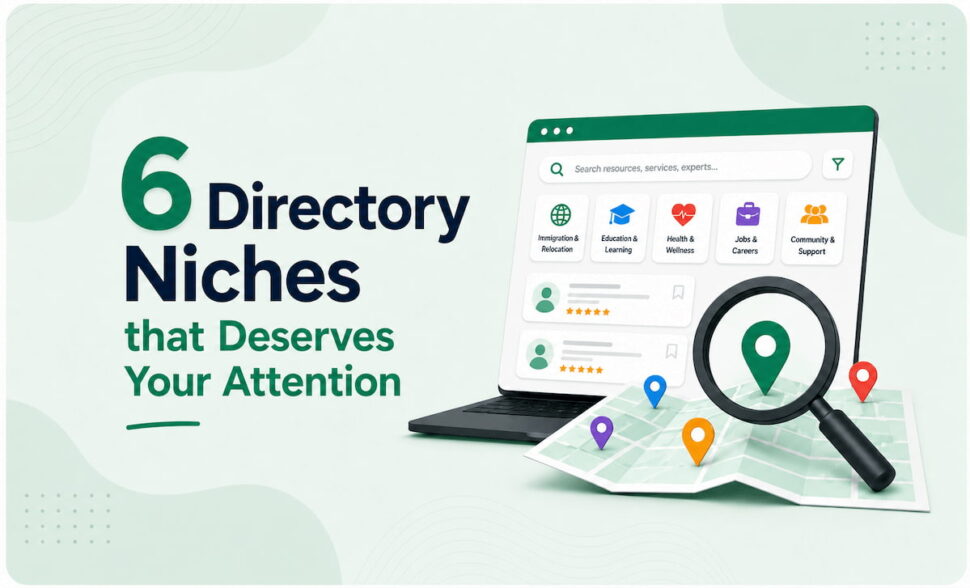
6 Directory Niches Nobody Is Building Yet (But Should Be)
-

- Directory Niche
- 12 mins read
The best directory to build right now is probably one you’ve never seen built yet. That’s not a guess – it’s how every dominant directory got its position. Yelp was built into a gap. TripAdvisor was built into a gap. The freelancer marketplaces of the 2010s were just like other directory website ideas built into gaps that looked niche at the time and turned out to be massive.
Think about immigration for a moment. At some point, almost everyone around you has faced it – a relative navigating a visa, a friend relocating for work, a colleague trying to figure out which country even allows their profession.
The process is exhausting. Hours of searching lead to scattered Reddit threads, outdated government pages, and a handful of individual lawyer websites with no reviews and no way to compare. You just want someone to point you to the right person, in the right country, who has actually helped people in your situation before.
A well-organized resource hub – a directory of vetted immigration lawyers and relocation consultants, filterable by country, language, and specialty, could solve that completely. Most people who have felt that frustration never made that connection. Not because the idea is difficult, but because of the box we’ve built around what a directory is supposed to be.
The Real Definition of a Directory (That Most People Miss)
We picture a directory and we see a list of businesses, places, people, or products. That’s not wrong – those models work, and some of the most visited websites in the world are built on them. But they are also the most saturated.
Local business directories, restaurant guides, and job boards already have incumbents with years of SEO equity behind them. Building into those categories without a sharply defined geographic or category focus is an uphill climb from day one.
A directory, at its core, is just a trusted, organized, searchable collection of anything people are actively trying to find. The format is not the constraint. The directory niche is.
The directories being built right now that will matter in three years are almost certainly not in the obvious categories. They are in niches where demand is clearly building, the supply is scattered across forums and social media groups, and no one has yet done the work of bringing it together into one trusted platform.
The data already shows people searching. The providers already exist. What’s missing is the curation layer and the person willing to build it. Do that well, and you are not just running a directory. You are building the next Yelp or Trustpilot for a direction nobody else is looking.
Why Winning Niches Matter More Than Ever
A directory niche worth entering in 2026 shares three characteristics. Understanding them is what separates a directory that compounds over time from one that stalls after the first hundred listings.
Fragmented supply, high-intent demand
There are providers or services people genuinely want to find, but those providers are scattered across Reddit threads, Facebook groups, and poorly ranked individual websites. Google can surface them, but cannot curate or validate them. That gap is where a directory creates real value.
A trust problem
The higher the stakes of a bad decision, the more a curated, reviewed directory earns its place. Niches where people can be scammed, misled, or simply let down by a poor choice are directory website niches where a trusted platform commands attention and justifies premium listing fees. Trust is the product, not just the feature.
Willingness to pay on the supply side
Listing owners who are already spending money on lead generation platforms such as Google Ads, paid directories in adjacent spaces, industry events etc. will pay for a directory that delivers qualified traffic. If the providers in a directory niche have zero marketing budget and no history of paying for discovery, monetization is an uphill battle regardless of how good the directory is.
When Discovery Is Solved, Directories Become Something Else
Look at what happened to the platforms that got there first. Hotels.com, Booking.com, and TripAdvisor started as discovery tools – they solved a genuine problem by aggregating supply that was previously scattered. That was enough to build massive audiences.
But once discovery was solved and the market consolidated, those platforms faced a harder challenge. With every competitor listing the same hotels, the directory advantage disappeared. The only way to retain users was to move into conversion like exclusive deals, loyalty programs, price-match guarantees, flash discounts.
The product shifted from “find the right hotel” to “get the best price on the hotel you already found.” That shift is expensive to sustain. It requires direct relationships with suppliers, negotiated margins, and continuous promotional spend just to stay relevant. The platform is no longer running on the value of its curation – it is running on its ability to undercut.
A directory built into a genuinely underserved directory niche does not face that problem yet. Discovery, trust, and a reliable flow of accurate information are enough. Listing owners pay because they are being found by people they could not reach otherwise. Users return because the platform saves them real time and reduces real risk. Neither side needs a discount to stay engaged, they need the platform to keep working.
That is a significantly better position to build from. And it is available right now in the niches below, precisely because nobody has done it yet.
6 Niche Directory Website Ideas Worth Considering
Here are six niches nobody is building yet, but should be. All of them meet the above criteria and none of them are fully served by an existing platform. (Till date, based on our observation.) So instead of searching “what directory should I build” online, deep dive into the below ideas and find the one that fits your expertise.
1. Vetted Immigration and Relocation Services

Post-election searches for international relocation spiked by over 1,500% in November 2024 and relocation tech company moveBuddha reported an 854% surge in traffic to its international moving content within two days of the result. Those numbers settled, but the underlying interest did not.
Search volume around “immigration lawyer [country]”, “relocation consultant”, and destination-specific queries like “moving to Portugal” and “digital nomad visa” has remained elevated well above pre-2024 levels. The audience is motivated and research-intensive – exactly the kind of user who benefits from a curated directory over a raw search results page.
The trust problem here is significant. Immigration is high-stakes, fraud is common, and the difference between a competent and an incompetent service provider can mean years of delays or financial loss. People searching for immigration lawyers or relocation consultants are not browsing casually. They are trying to make a decision they can’t easily undo.
On the supply side, immigration lawyers already pay some of the highest Google Ads CPCs of any professional services category. A directory that delivers qualified, motivated leads has a clear value proposition for listing owners at premium price points.
What does not exist yet is a directory that combines verified credentials, authentic reviews, service-area filtering (which countries a practitioner covers), and language-matching. Yelp doesn’t handle cross-border service discovery. Martindale-Hubbell covers lawyers broadly. No one owns this specific intersection.
Building it with Directorist: Custom fields per listing category such as credentials, languages, countries covered, consultation pricing etc. handle the data complexity. The review system, admin approval workflow, and private directory option give you the moderation tools to keep quality high and trust intact.
2. AI Agent Builders and Automation Specialists

Agentic AI systems that handle full workflows autonomously has reached a $9.14 billion market size by 2026 and projected to expand into a $139.19 billion size by 2034. (Source: Fortune Business Insights)
Over 90% of IT leaders reported plans to deploy autonomous agents to accomplish their tasks. The problem is that most of the businesses who need these systems have no idea how to build them or find someone who can do it for them. The later problem is partially solved through LinkedIn outreach, various lead funnels and marketplaces. But no one has an end-to-end resource hub ready yet.
The discovery landscape for AI automation specialists remains poor as LinkedIn, Upwork and Fiverr remains only option with fewer choices and there is no vetting infrastructure. No specialist directory exists for people who build AI agents, automation workflows, or LLM-powered tools for business use.
To understand the kind of specialist this directory would serve, consider what businesses are actually searching for: dedicated teams that design and deploy agents end-to-end. Companies like Altamira AI agent development services represent exactly the supply side of this niche – experienced, project-ready, and currently discoverable only through generic channels.
The audience searching for these services is not price-sensitive. A business deploying an AI agent to handle customer service or internal processes is making a significant operational decision, and they will pay for access to pre-vetted, reviewable specialists rather than sifting through a generic freelancer marketplace.
This directory niche will not stay empty for long. The window to build authority in AI agent discovery is narrow.
Building it with Directorist: Skill-based filtering (which platforms or tools a specialist works with (such as n8n, Make, OpenClaw, Claude, Zapier), project type categories, and verified portfolio links make the listings genuinely useful. The multi-directory feature lets you expand into adjacent specializations as the category matures.
3. Longevity and Preventive Health Practitioners

The longevity and precision medicine market is projected to reach $106 billion by 2033. The interest has moved well beyond early adopters: mainstream search volume for terms like “longevity doctor”, “biohacking clinic”, “functional medicine practitioner”, and “metabolic health specialist” has grown consistently over the past two years.
The discovery problem is real. Practitioners in this space – longevity physicians, functional medicine doctors, health optimization coaches, metabolic specialists are not easy to find through conventional channels. The NHS and standard US insurance directories do not categorize by these specializations. Healthgrades and Zocdoc are built for conventional primary care and specialties. The gap between what a motivated health consumer is searching for and what existing platforms surface is significant.
On the supply side, practitioners in this space typically operate outside insurance networks, charge directly, and are actively seeking new patients. They already invest in content marketing and paid search. A directory with strong SEO in longevity-related search terms would deliver exactly the traffic they want.
Building it with Directorist: Geo-radius search is critical here – users need to find practitioners within a commutable distance. Appointment booking with calendar integration, filter by specialty type, and a review system that captures treatment outcomes (not just bedside manner) would differentiate this from a generic health directory.
4. Halal-Certified Products and Services

The global halal economy covers food, cosmetics, pharmaceuticals, finance, tourism, and professional services. Muslim consumers represent approximately 1.8 billion people worldwide, with significant and growing purchasing power in Western markets including the UK, US, Canada, France, and Germany. The demand is not niche – it is large, consistent, and underserved by current discovery infrastructure.
The trust problem is acute. Halal certification varies by certifying body, country, and product category. Consumers cannot rely on packaging alone, and mainstream platforms like Google Maps and Yelp do not filter by certification status. The result is that halal discovery happens primarily through word-of-mouth, community social media groups, and a fragmented set of region-specific apps with limited coverage.
A directory that covers multiple categories – restaurants, cosmetics brands, financial products, travel services, all filtered by certifying body and geography, and validated through a combination of certification documentation and community reviews, would serve a large audience with no adequate existing alternative.
Revenue potential is substantial. Businesses actively seeking halal-certified audiences such as restaurants, food manufacturers, cosmetics brands, banks offering halal financial products would also pay for qualified placement.
Building it with Directorist: The multi-directory feature on a single WordPress install lets you run halal restaurants, halal cosmetics, and halal travel services as separate, properly categorized directories without fragmenting the user experience. Custom fields for certification body and certification expiry date handle the validation layer. Shoutout to one of these platforms that we featured recently in our social media channels.
5. Sober-Friendly Venues and Experiences

Nearly 49% of Americans said in 2025 that they planned to drink less alcohol, a 44% increase since 2023. Among Gen Z specifically, 65% plan to cut back, and 39% plan to go fully alcohol-free for the entire year. Dry January participation has grown 36% year over year. (Source: Circana) This is not a passing resolution cycle – it is a sustained, three-year directional shift in how a large and growing segment of the population wants to socialize.
The discovery problem this creates is real and largely unsolved. Someone who doesn’t drink has no reliable way to find places like restaurants, cafes, events, or travel experiences that genuinely cater to them. What exists currently is scattered: a handful of city-specific blog posts, Instagram accounts run by individuals, and the occasional “mocktail menu” tag on a review that may or may not be current. No structured, searchable, trusted directory covers this audience.
The trust problem is also meaningful. Recommending a “sober-friendly” venue that turns out to have a two-drink minimum, or listing an event as alcohol-free when it isn’t, damages credibility instantly with an audience that has often had to navigate social situations carefully. A directory that gets this right with verified listings, community reviews, and consistent editorial standards earns loyalty that generic review platforms never could.
On the supply side, the non-alcoholic beverage market is projected to grow by $706.7 million by 2033. Venues, brands, and experience providers actively targeting the sober-curious audience are already spending on marketing. A directory that delivers a highly qualified, self-selected audience of non-drinkers is a compelling platform for that spend.
Building it with Directorist: Listing categories spanning venues, events, and travel experiences – each with custom fields for alcohol policy, mocktail menu availability, and atmosphere type that give users genuinely useful filter options. The review system captures the community validation this audience specifically relies on, and the multi-directory feature lets you expand from local venue listings into events and retreat experiences as the platform grows.
6. Specialist Retreat and Slow Travel Services

Wellness tourism is another growing market with mental health and intentional disconnection cited as primary drivers in close to half of wellness travel decisions. The segment specifically growing is not luxury spa resorts, it is smaller, specialist experiences: silent retreats, digital detox programs, forest therapy providers, slow travel itineraries, nature immersion retreats.
The discovery problem is significant. These providers are not found on Booking.com or TripAdvisor. They do not have the marketing budgets or SEO infrastructure to rank independently. They are found through niche travel blogs, Instagram accounts, and specialist newsletters – none of which scale well into a searchable, filterable resource.
Users searching in this space are making considered, high-value purchases. A weekend silent retreat or a two-week slow travel program is not an impulse buy. The audience researches carefully, trusts editorial curation, and is willing to pay for quality. Listing owners are independent retreat centers, specialist guides, slow travel facilitators who have limited discovery options and would welcome a focused platform.
Building it with Directorist: Custom fields for retreat type, duration, group size, language, and certification (yoga alliance, mindfulness training credentials, etc.) structure the listings appropriately. The booking extension integrates reservation management directly into the directory, reducing the friction between discovery and purchase.
Learn what it actually costs to build one →
A Note on Timing
Each of these directory website niches has demand building now, but no dominant directory has claimed authority yet. That gap closes gradually, then quickly – once one platform builds SEO equity and community trust in a directory niche, the cost of competing rises substantially.
The directories worth building in 2026 are not the obvious ones. They are the ones where the audience exists, the supply is scattered, and no one has yet done the work of bringing them together.
If one of these matches something you already know well – a community you are part of, an industry you have worked in, a problem you have personally navigated – that familiarity is the competitive advantage that makes the difference between a directory that grows and one that doesn’t.
Directorist gives you the infrastructure: custom fields, geo-search, review systems, monetization, and listing management. The domain knowledge and the directory niche judgment are yours to bring.
Take a look at what Directorist includes at each plan level and start with the one that matches where you are now.

Related Post

S. M. Navid Anjum
Digital Marketing enthusiast who loves to write technical reviews and trendy contents. Currently working with WordPress Plugin Marketing and growth. Open to collaboration and co-marketing opportunities with any SaaS and plugins.
Leave a Reply
You must be logged in to post a comment.