 Up to 35% Off!


Table of Contents
- 1 Why a Directory Site Needs a Blog
- 2 9 Steps to Write Blog Posts for a Directory Website
- 2.1 Step 1: Know who you're writing for
- 2.2 Step 2: Pull topics from what your directory actually covers
- 2.3 Step 3: Understand what the searcher actually wants
- 2.4 Step 4: Plan the structure before you write
- 2.5 Step 5: Write a title that tells the reader what they'll get
- 2.6 Step 6: Apply SEO basics without overthinking them
- 2.7 Step 7: Link posts to listings and directory pages
- 2.8 Step 8: Edit before you publish
- 2.9 Step 9: End with one clear next step
- 3 What to Blog About for a Directory Site
- 4 Where to Go From Here
- 5 FAQ
How to Write Blog Posts for a Directory Website
-

- Tutorials Directorist
- 9 mins read
Most blogging advice is written for content publishers, personal blogs, and SaaS companies. It tells you to write consistently, optimize for keywords, and build an audience. That advice is fine as far as it goes, but it doesn’t account for what makes a directory site different.
Your blog isn’t just a content channel. It’s part of how people find your listings, how listing owners discover your platform, and how your site builds enough trust to compete in local or niche search. Writing that ignores that context produces content that gets some traffic and sends it nowhere useful.
This guide is about writing blog posts that actually serve a directory website.
Why a Directory Site Needs a Blog
There are three reasons blogging works well for directories, and they’re different from why most sites blog.
It brings people in before they know your directory exists. Someone searching “best dentists in [city]” or “how to find a reliable electrician” isn’t looking for your directory by name, they’re looking for an answer. A well-written post can show up in those results, answer the question, and send the reader straight to your listings. The blog functions as a front door.
It gives listing owners a reason to find you. A post titled “How to get your local business found online” or “Why your service business needs a directory listing” speaks directly to the people you want to sign up. They search for that kind of guidance, find your blog, and arrive at your site already warmed up to the idea of listing with you.
It shows the platform is active. A directory with no content looks like a database that nobody tends. Regular posts tell visitors and search engines that someone is running this thing and paying attention to the niche.
9 Steps to Write Blog Posts for a Directory Website
Before you start, remember that AI tools can help with outlines or rough drafts, but directory blog posts still need specific categories, local details, and examples from real listings. If you use AI to get started, a free AI humanizer can smooth out the stiff phrasing, and the final editing step below covers the full review process.
Step 1: Know who you’re writing for
A directory blog serves two different audiences, and most posts should choose one or the other.
The first is your end users, people searching for a business, service, or resource. They want to find something. Your content for them is discovery-focused: guides, roundups, comparisons, local recommendations.
The second is listing owners, businesses and individuals who might want to be listed on your platform. They want visibility and leads. Your content for them is value-focused: why directories work, how to write a strong listing, what makes one listing get more clicks than another.
Know which one you’re writing for before you start. The tone, topic, and CTA will be different for each.
Step 2: Pull topics from what your directory actually covers

Generic topics like: “how to grow your business,” “tips for entrepreneurs” are dominated by high-authority publishers you can’t outcompete. Don’t write them.
Instead, draw topics directly from your directory’s categories, locations, and niche. A restaurant directory should blog about dining guides, cuisine types, neighborhood food scenes, and advice for restaurant owners. A job board directory should cover hiring tips, industry salary expectations, and how to write a job listing that attracts applicants. A local business directory should cover local guides, category roundups, and advice for service businesses in your area.
This specificity is what gives your content a realistic chance of ranking. The more precisely your topic matches your directory’s niche, the less competition you’ll face and the more relevant the traffic you attract.
Step 3: Understand what the searcher actually wants
Search intent is the reason behind a search query. Someone typing “best coffee shops in London” wants a curated list. Someone typing “how to start a coffee shop” wants a step-by-step guide. Same topic, completely different content.
Before you write a post, be clear on what someone searching your target term is actually trying to do. If they want a list, write a list. If they want a how-to, write a how-to. If they want a comparison, write a comparison.
A post that doesn’t match the intent behind the search will lose readers quickly, regardless of how well it’s written. High bounce rates on a page signal to Google that the content didn’t satisfy the searcher, which pushes rankings down over time.
Step 4: Plan the structure before you write
An outline takes ten minutes and saves an hour of rewriting. Before you write a single sentence of the post, write down:
- The exact question this post is answering
- The sections you’ll need to cover it fully
- The order those sections should appear in
A workable structure for most directory blog posts:
- Intro: state the problem or question clearly, no slow warm-up, no vague preamble
- Body: answer it in clearly labeled sections, one idea per section
- Conclusion: one specific next step, not a summary of what you just said
If a heading covers two separate ideas, split it into two sections. Readers skim, and clear structure helps them find what they need.
Step 5: Write a title that tells the reader what they’ll get
Your title tag (what appears in search results) and your H1 (the heading on the page) should say the same thing, or be very close. When they disagree, it signals a disconnect to both readers and search engines.
A good title is specific and honest. “7 Types of Businesses to List in a City Directory” is better than “Amazing Ideas for Your Business Directory Blog” because it tells the reader exactly what’s inside. Vague titles get lower click rates, even when they rank.
Keep your title tag under 60 characters so it doesn’t get cut off in search results. Count the characters before you publish.
Step 6: Apply SEO basics without overthinking them
You don’t need to become an SEO expert to blog effectively for a directory site. The essentials are straightforward.
Use your target keyword in the title, the first paragraph, and at least one subheading. After that, write naturally, don’t force it into every sentence.
Write a meta description of around 150 characters that summarizes the post and gives a reason to click. It won’t directly affect your ranking, but it affects whether someone chooses your result over the ones next to it.
Keep your URL short and descriptive. /blog/best-plumbers-manchester is better than /blog/?p=4821.
Structure your post with real subheadings (H2, H3) not just bold text. Subheadings help readers navigate and tell search engines how the content is organized.
Step 7: Link posts to listings and directory pages
This is the step most directory blogs miss, and it’s the most important one for the site’s actual purpose.
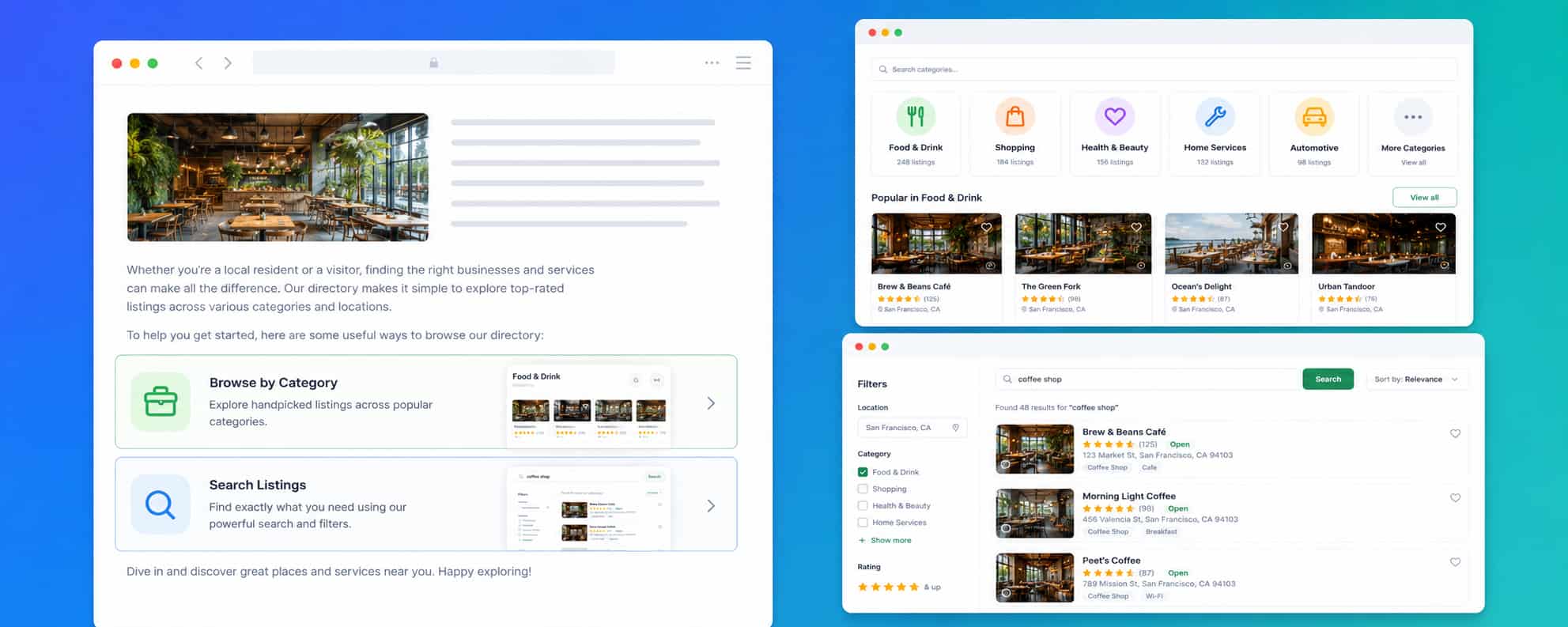
Every blog post should send readers somewhere inside your directory. A post about “Top yoga studios in Chicago” should link to the yoga category in your Chicago listings. A post about “How to get your café listed online” should link to your listing submission page. A post about finding a reliable contractor should link to your contractor category search.
The blog is a path into the directory. If it doesn’t lead there, it’s doing an incomplete job.
Step 8: Edit before you publish
Publishing a post with grammar errors, broken logic, or vague claims costs you credibility. Read the post from the top and ask three questions:
- Is every sentence clear the first time you read it?
- Does any sentence repeat what the previous paragraph already covered?
- Are there any claims that have no supporting example or source?
Watch for specific grammar mistakes that undermine credibility: “advise” used where “advice” is correct, “compliment” where “complement” is correct, “keyword stuffing” confused with “keyword staffing.” These are small errors but readers notice them.
If you’re working with writers or using AI tools to produce drafts, use an AI checker to pinpoint generated patterns, then humanize AI content that reads as machine-written. For paragraphs that need heavier reworking, a tool like rewrite my paper can help you restructure them quickly. Catching these issues before publishing is faster than fixing them after the page is live.
Step 9: End with one clear next step
Most blog posts end with a vague “We hope this was helpful” or a generic subscribe prompt. Give readers somewhere to go that’s relevant to what they just read.
For posts aimed at end users, the CTA should lead to a search page, a category, or a relevant listing. For posts aimed at potential listing owners, it should lead to your submission page or pricing.
One specific action is better than a list of options. If you give readers three things to do, they’ll often do none of them.
What to Blog About for a Directory Site
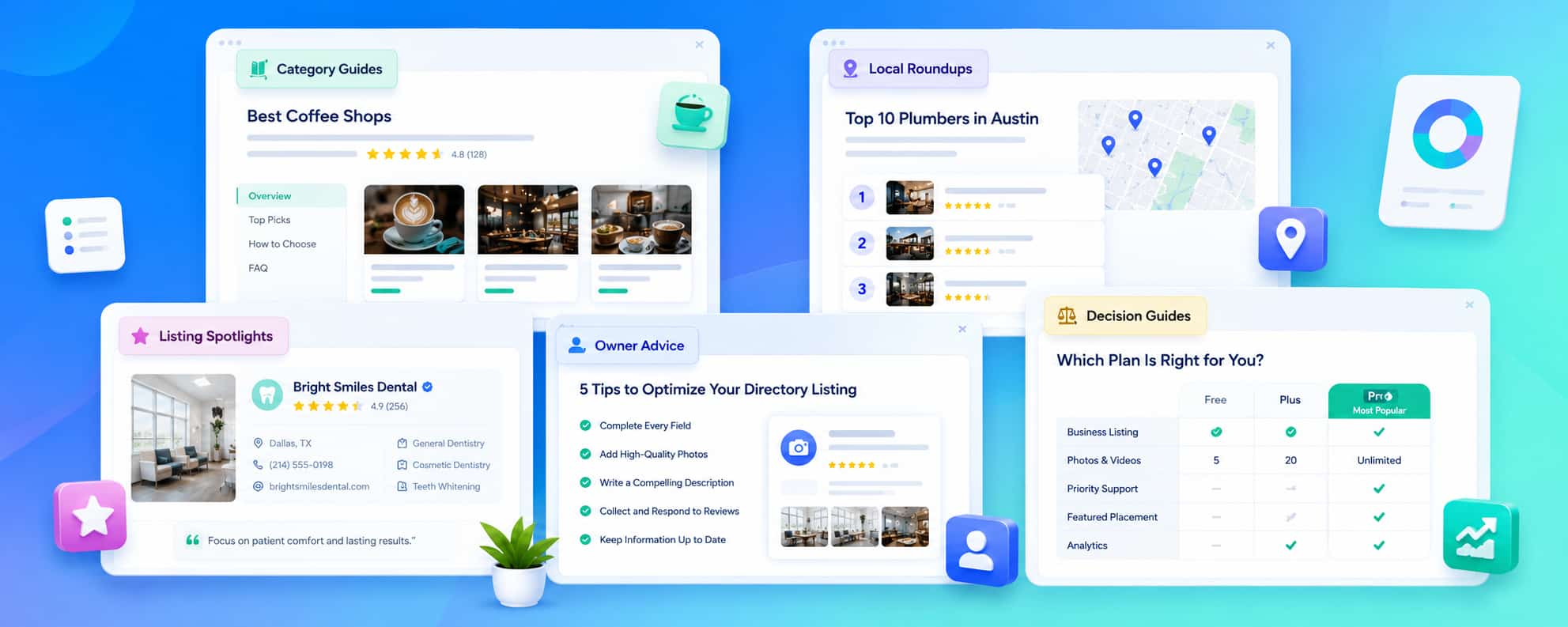
If you’re building out an editorial calendar, these content types consistently work well for directories:
Category guides are posts that cover everything about a specific listing category in your directory. “Your Complete Guide to Finding a Personal Trainer in [City]” targets local intent, showcases your listings, and serves a specific segment of your audience.
Local roundups (“10 Family-Friendly Restaurants in [Neighborhood]”) have high local search intent, link naturally to your listings, and give businesses a reason to share your content with their own audiences.
Listing spotlights feature a specific business or service with a short profile or interview. They’re good for community building, give listing owners something worth sharing, and generate goodwill with people already using your platform.
Advice for listing owners – posts like “How to write a listing that gets more calls” or “What information to include in your business profile” help your existing listing owners get more from your platform and attract new ones searching for that kind of guidance.
Decision guides (“Best [Category] in [City]: What to Look for Before You Book”) answer a question buyers ask at the moment they’re ready to act. High buying intent and direct relevance to your listings.
Where to Go From Here
Knowing your audience is very important for your writing output. Whether you’re convincing a group of A directory blog that treats content as part of the platform, not a separate publication, will outperform one that produces generic posts and hopes for traffic.
The most reliable formula: write about topics your directory specifically covers, serve the intent behind each search precisely, and send every reader somewhere useful inside your directory.
If you’re setting up a new directory or expanding your blog strategy, the Directorist features page shows you what the platform includes and where to start. Or download the free version and explore it against your own requirements.
For a deeper look at getting your directory found in search, read the Directorist guide to directory website SEO.
FAQ
Does a directory website need a blog?
Not every directory does, but a blog is one of the most reliable ways to bring in new visitors through organic search. A directory that relies entirely on direct traffic or paid channels has no compounding asset working for it. Blog posts, once they rank, keep delivering traffic without ongoing cost.
How often should I publish blog posts for my directory?
Consistency matters more than frequency. One well-researched, well-written post per month is more useful than four rushed posts per week. Write when you have something worth saying about your directory’s niche, and don’t publish filler to hit a schedule.
How long should a directory blog post be?
Long enough to fully answer the question, short enough to cut everything that doesn’t. Most directory blog posts land between 1,000 and 2,000 words. Local roundups can be shorter. In-depth guides can run longer. The question to ask is whether each section earns its place, not whether the total word count looks right.
Can I use AI tools to write directory blog posts?
AI tools can help with drafts, outlines, and editing passes. The risk is that generic AI output lacks specific knowledge of your directory, your market, and your listings. Use it to speed up parts of the process, then edit to add the local knowledge, specific examples, and direct voice that makes directory content useful.
How do I come up with blog post topics?
Start with your listing categories. Every category is a potential topic cluster, guides for finding businesses in that category, advice for businesses that want to list in it, comparisons of options. From there, look at what people search when they’re trying to find or evaluate the kinds of businesses in your directory.
Follow Directorist on X/Twitter, Facebook, LinkedIn, and Instagram for more guides on building and growing a directory business.


Editorial Staff
Directorist Editorial Staff is a team of WordPress geeks that provides quality content for WordPress users. Primarily the team works for all the ingredients needed for establishing a directory listing website in WordPress. Moreover, you will get numerous web content related to the WordPress blog, Digital marketing stuff, social post, text documentation, visual guides, and so on.


Leave a Reply
You must be logged in to post a comment.