
Table of Contents
- 1 What Features You Should Include In Your Real Estate Directory
- 1.1 1. Advanced Search and Filters
- 1.2 2. Detailed Property Listing Pages
- 1.3 3. Property Categories and Custom Fields
- 1.4 4. Interactive Map Integration
- 1.5 5. Frontend Listing Submission
- 1.6 6. User Dashboard
- 1.7 7. Image Gallery and Media Support
- 1.8 8. Agent and Agency Profiles
- 1.9 9. Contact and Inquiry Forms
- 1.10 10. Reviews and Ratings
- 1.11 11. Saved Listings or Favourites
- 1.12 12. Mobile-Friendly Design
- 1.13 13. Listing Status Labels
- 1.14 14. Monetization Features
- 1.15 15. Payment Gateway Support
- 1.16 16. Booking or Appointment Requests
- 1.17 17. Listing FAQs
- 1.18 18. Business Hours
- 1.19 19. SEO-Friendly Structure
- 1.20 20. Admin Moderation and Listing Approval
- 2 How to Create a Real Estate Directory Website
- 3 Bonus Tips
- 4 Wrapping up
How to Create a Real Estate Directory Website Like Zillow
-

- Directorist Tutorials
- 14 mins read
Want to create a real estate directory site like Zillow without spending a lot of money? This topic will not be about discussing the benefits of creating a real estate directory or similar resources (you already know that). Rather than, you’ll get a laser-shot tutorial on how to build a site like Zillow.
You can start your real estate directory with less than $100! Sounds cool, right? In this tutorial, we’ll use a WordPress plugin named “Directorist” and a WordPress Real Estate Directory Theme called “dRealEstate“. With these two tools, we’re ready to build your real estate website. So without wasting any more time, let’s start creating your real estate directory.
What Features You Should Include In Your Real Estate Directory
Before building a real estate directory, you need to know what features actually make a real estate directory useful. The right features affect everything, from how people browse properties to how agents manage listings and how you grow the platform over time. Some features elevate the user’s journey, some help with trust, and some make monetization possible. Together, they shape the foundation of a successful directory. Here are some core features that you should keep in mind while creating a real estate directory website.
1. Advanced Search and Filters
This is one of the first things users notice. Property seekers want quick results by location, price, property type, bedrooms, bathrooms, and other details through search and filters. Without strong filters, even a well-designed directory can feel frustrating to use.
2. Detailed Property Listing Pages
A listing page should answer the basic questions fast. Price, photos, location, size, description, amenities, and contact details all need to be easy to find. The clearer make easier for users to compare options and take action.
3. Property Categories and Custom Fields
Not every property fits into the same category, so it needs flexibility. A real estate directory should support categories like apartments, villas, land, offices, and rentals, with custom fields for details that make each listing more useful. This structure also helps improve search and filtering for the users.
4. Interactive Map Integration
Many users want to explore properties by their area, neighbourhood, or nearby landmarks before they even open a listing. A map feature makes browsing more visual and often much more practical.
5. Frontend Listing Submission
A frontend listing submission is an easy process to collect listings from the property owner. It allows agents or property owners to add their listings without accessing the backend. This helps improve usability and makes it easier to site to grow.
6. User Dashboard
Once property owners submit listings, they need a dashboard to manage them. A user dashboard lets them edit details, renew expired listings, remove old properties, and track submissions in one place. That saves time for both the user and the site owner.
7. Image Gallery and Media Support
Real estate is highly visual, so media support is not optional. Listings should be able to include multiple photos, galleries, floor plans, and even video or virtual tour links. This helps users understand the property before they make contact.
8. Agent and Agency Profiles
A lot of users want to know who they are dealing with, not just what property is available. Dedicated profile pages for agents and agencies help add that layer of trust. They also make the directory feel more complete and professional.
9. Contact and Inquiry Forms
A listing should make it easy to reach out. Whether that is through a contact form, phone number, email button, or request form, the goal is simple: ease the path between interest and inquiry. The easier it is to contact someone, the better the conversion potential.
10. Reviews and Ratings
Trust matters in real estate, especially when agencies and agents are involved. Reviews and ratings can help users compare providers and feel more confident before making contact. They also add social proof to the platform.
11. Saved Listings or Favourites
Property seekers rarely decide on the first listing they see. Many want to save a few options, compare them later, and come back after thinking things through. A favourites feature supports that behaviour and keeps users engaged longer.
12. Mobile-Friendly Design
A real estate directory needs to work well on phones, not just desktops. Many users browse listings on mobile while commuting, comparing options, or sharing links with others. If the mobile experience feels clumsy, the whole site can lose credibility fast.
13. Listing Status Labels
Small labels can make a big difference in usability. Tags like for sale, for rent, sold, rented, or featured help users understand listing status at a glance. They also make property cards and archive pages easier to scan.
14. Monetization Features
If the goal is to turn the directory into a business, revenue features should not be an afterthought. Paid submissions, featured listings, membership plans, or agency packages can all help create a sustainable model. It is much easier to build around monetization from the start than to force it in later.
15. Payment Gateway Support
Monetization only works smoothly when payments do too. If you plan to charge for listings or premium placements, your directory should support secure and easy online payments. That keeps the process convenient for users and manageable for you.
16. Booking or Appointment Requests
In many cases, users want more than just contact details. They want to schedule a viewing, book a consultation, or request a callback. A booking or appointment feature can make the directory more action-driven and useful in real-world situations.
17. Listing FAQs
A lot of listing questions are predictable. Buyers and renters may want to know about availability, payment terms, neighbourhood details, or viewing rules. An FAQ section helps answer those questions upfront and makes the listing feel more complete.
18. Business Hours
This may seem like a small feature, but it can still be useful, especially for agencies and real estate offices. Showing business hours gives users one more piece of practical information before they call or visit. It also adds a bit more trust to the listing or profile.
19. SEO-Friendly Structure
A real estate directory should be built in a way that search engines can understand and rank. Clean URLs, area pages, category pages, internal links, and schema support all help strengthen visibility over time. This matters a lot if you want the site to attract long-term organic traffic.
20. Admin Moderation and Listing Approval
Open submission is useful, but it also creates quality control issues. Admin moderation helps you review listings before they go live, remove spam, and maintain a better standard across the directory. That becomes more important as the platform grows.
These features give you a clearer idea of what to look for before creating a real estate directory. Once you know which features matter most, choosing the right setup becomes much easier. From there, the next step is to build the site with tools that can actually support those features without making the process harder than it needs to be.
How to Create a Real Estate Directory Website
We hope that you already aware about all the features that you include on your real estate directory. So, the next question is comes that how you’ll do it. At this technology era, there are many tools available. With these no code tools you can easily create your real estate directory website. Today we’ll use We’ll use WordPress. Why? Because it has beginner-friendly dashboard, no coding required, offer a huge plugin ecosystem and easy to scale later.
Step 1: Set Up the Foundation
Domain & Hosting
You need two things:
- A domain name (your website address)
- Hosting (where your website lives)
Choose a short, memorable domain related to real estate or location. You can also use tools that spark domain ideas instantly to help brainstorm unique and brandable names for your website. Pick a hosting that supports WordPress and offers one-click installation.
Helpful guides:
- Top WordPress Hosting Services for Directory Websites (2025)
- WordPress Hosting Guidance for Making Faster & Safer Directory Listing Websites
Install WordPress
Most hosting providers install WordPress for you automatically.
If not, you can follow a simple tutorial:
Once installed, you’ll have access to the WordPress dashboard.
Step 2: Add Directory Functionality
Install the Directory Plugin
Now comes the core part. For this tutorial, we will be using Directorist as it is the most scalable and versatile WordPress directory plugin you can find in the WordPress repository.
The free features include a drag & drop page builder with unlimited custom fields, free page builder integrations (Elementor & Gutenberg), multi-directory, OpenStreetMap, Google Maps, frontend listing submissions, frontend dashboard for users, SEO plugin integration, ratings & reviews, WPML integration, RTL support, CSV bulk import-export, and many more.
The plugin has a whole range of premium features that will stun you with its 4.7 user ratings out of 5. Currently, it has more than a 20K user base from around the world. So, rest assured of the quality of the plugin.)
This plugin handles:
- Property listings
- Frontend submissions
- Search and filters
- User dashboards
- Monetization options
Think of it as the engine behind your Zillow-like site.
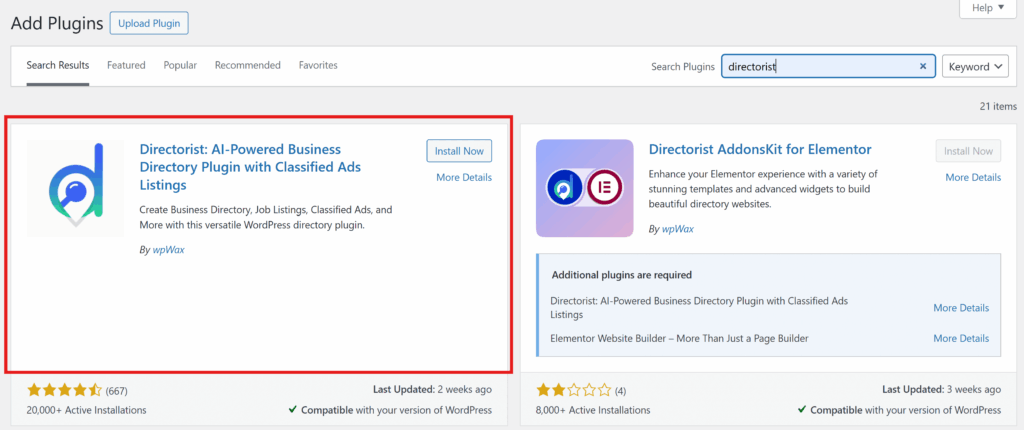
To install, navigate to the WP Admin Dashboard > Plugins > Add New > Search for the keyword ‘Directorist’ > Hit the “Install Now” button (as indicated with arrows).
Next up, you need to activate and configure the setup wizard to make a fresh start. After setup, some additional tools suggestions will appear at the top. These tools are recommended for better performance. We recommend you to visit our official documentation so that you can configure it perfectly or the way you want.
Install a Real Estate Theme
You can use any popular WordPress theme to use with Directorist. Because the tool is fully compatible with all WordPress themes. But we recommend you use a directory niche-based theme to get the best results. For this tutorial, we’ll use dRealEstate.
Navigate to the WP Admin Dashboard > Appearance > Themes > Add New.

The theme controls:
- Layout
- Design
- Property page structure
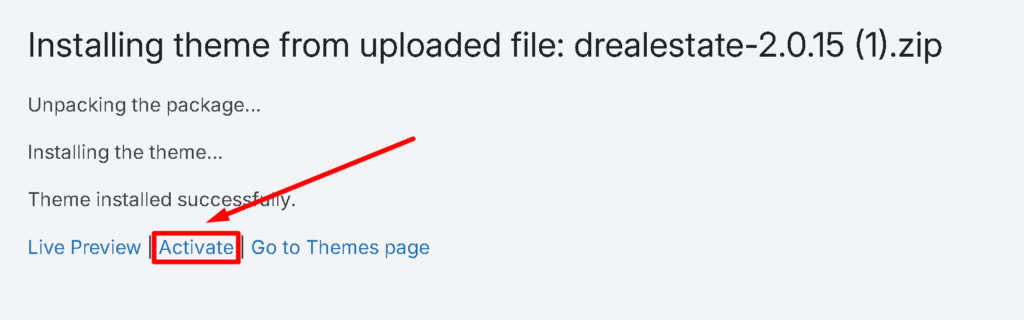
Finally, activate the theme to take an effect by clicking the ‘Activate’ button:
You can enjoy the professional look out of the box by using wpWax Demo Importer. For this, Dashboard > Tools > wpWax Demo Importer. Taking a pre-caution backup of your website is recommended before using the wpWax Demo Importer as it will replace the whole design.
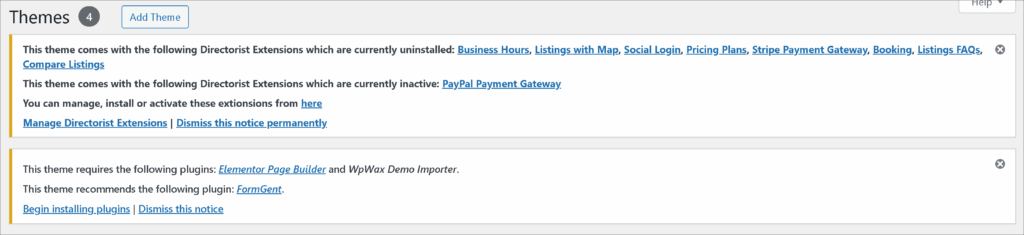
Once you install the theme, you will see a suggestion in the form of a notification to install some supplementary plugins and tools. They are necessary to run the theme perfectly. So, make sure to install them using the “Begin Installing Plugins” option.
And that’s it!
Make You Real Estate Directory more professional and functional
To make the site more professional and functional like Zillow, some extensions are recommended. To keep you one step ahead, dRealEstate theme comes with all the required extensions that needs to make a solid move. You will get every detail how these extensions word by following the documentation sections. If you face any issues, don’t hesitate to contact in our support section.
- Listing With Map (Learn more how it works)
- Social Login (Learn more how it works)
- Pricing Plans (Learn more how it works)
- PayPal Payment Gateway (Learn more how it works)
- Stripe Payment Gateway (Learn more how it works)
- Live Chat (Learn more how it works)
Beyond these recommended extensions, Directorist offer few more amazing extensions that you should check out.
- Directorist Analytics (Learn more how it works)
- Directorist Advanced Review (Learn more how it works)
- Directorist Universal Search (Learn more how it works)
- Directorist Search Alert (Learn more how it works)
- Directorist Announcement
- AddonsKit for Bricks
- HelpGent Integration (Learn more how it works)
- WPML Integration (Learn more how it works)
- Digital Marketplace (Learn more how it works)
- Job Manager (Learn more how it works)
- Booking (Reservation & Appointment) (Learn more how it works)
- Listings with Map (Learn more how it works)
- Business Hours (Learn more how it works)
- WooCommerce Pricing Plans (Learn more how it works)
- Gamipress Integration (Learn more how it works)
- Mailchimp Integration (Learn more how it works)
- Multi Directory Linking (Learn more how it works)
- BuddyPress Integration (Learn more how it works)
- BuddyBoss Integration (Learn more how it works)
- Oxygen Builder Integration (Learn more how it works)
- Authorize.net Payment Gateway (Learn more how it works)
- Directorist Coupon (Learn more how it works)
- Directorist Ads Manager (Learn more how it works)
- Compare Listings (Learn more how it works)
- Mark as Sold (Learn more how it works)
- Image Gallery (Learn more how it works)
- Listing FAQs (Learn more how it works)
- Listing Slider & Carousel (Learn more how it works)
- Google reCAPTCHA (Learn more how it works)
- Claim Listing (Learn more how it works)
Step 3: Build and Customize Your Site
Design the Site
Customize your theme if necessary:
- Change colors
- Update fonts
- Adjust layouts
- Update Images
Everything is visual. No coding required.
You can learn more about customizing your directory website from out ultimate guide: Ultimate Guide to Create a Directory Website
Add New Categories and Tags
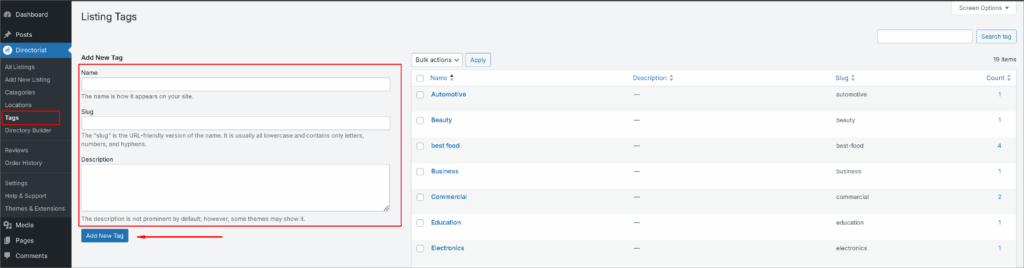
Creating categories and tags allows you to keep your directory website neat and tidy. The listing owners can choose relevant categories and tags to upload their listings. This way visitors can get their desired listings with ease.
In the Directorist menu, you will find both of these items where (category) you can also add images, assign the category to a parent one, give a description, add icons & colors, and even choose directory type (if you are using the multidirectory feature).
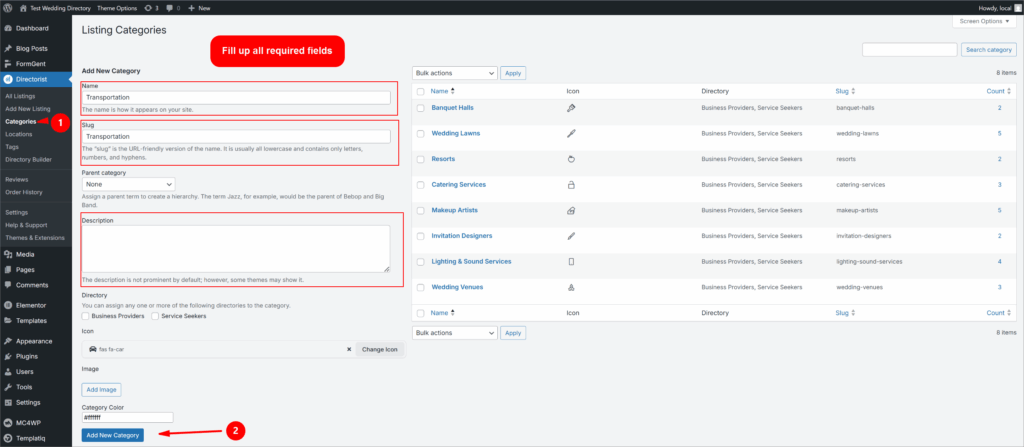
To add categories, you just need to go to the Directorist> Categories > Fill out the fields > Hit the “Add New Category” button.
Similarly, you can add tags from Directorist > Tags > Enter Credentials > Add New Tag.
Add New Locations
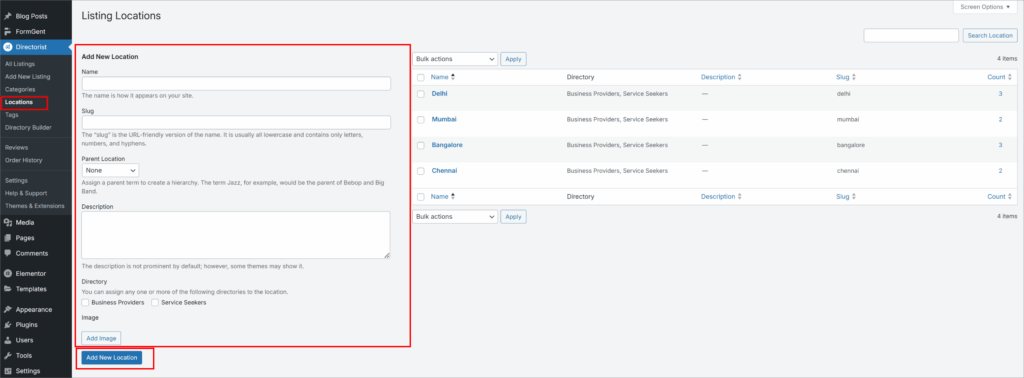
Just like adding categories or tags adding locations helps the users find the desired real estate property in a better way. Creating locations allows the listing owner to add locations that are really useful for the users to filter out while searching. To add locations, you have to go to the Directorist > Locations > Enter credentials (name, description, directory type, etc.) > Hit the Add New Location button.
Create Listing Submission Form
A submission form is required to collect listings from the owners. You can create your customized listing form by using drag and drop fields. To do this: Directorist > Directory Builder > Add listing form
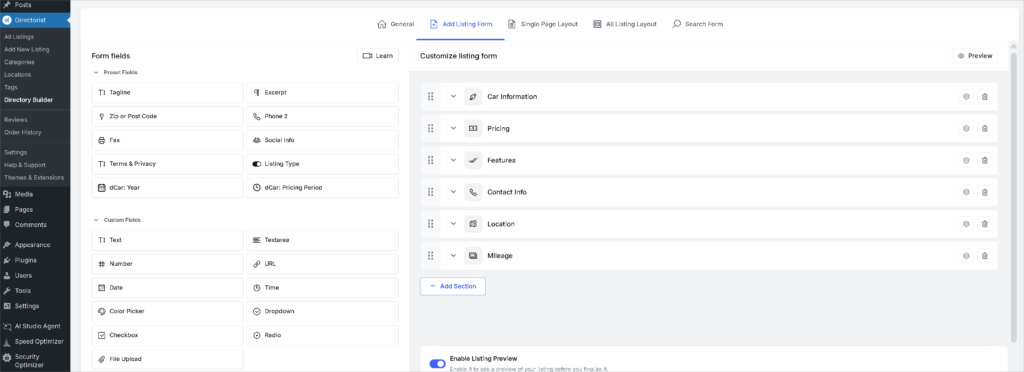
Now. your users can upload listings by navigating to the “Add Listing page”. Next up, the user will find the following submission form to submit his or her listings, he or she must fill out the required fields to proceed:
When you have a few listing owners and they submit a number of listings, the all listings page will look somewhat like this (depending upon the theme you choose):
So, you are already done with creating a basic real estate directory website. But one important aspect is yet to add – which is monetizing your directory website. The following section shows the ways to monetize your real estate directory website.
Step 4: Adding Advanced feature: Monetizing your directory website
With Directorist, you can monetize your website in a number of ways that can enable you to earn a huge pile of revenue:
- Charge for listings (Free)
- Featured listings (Free)
- Allow businesses to claim listings (Premium)
- Charge for viewing private listings (Premium)
- Allow private/sponsored advertising (premium)
- Charge for membership (Premium)
- Sell business leads (Premium)
- Promote affiliate products (Premium)
- Allow sponsored articles/guest posting (Premium)
- Bookings & appointment (Premium)
- Access control (Via 3rd party plugin)
- Ranked featured lists (Premium)
- Paid ad placement (Premium)
Want to learn these ways in detail? Give a read to this article, “How to Monetize a Directory Listing Website” now!
You can use the first 2 free ways to monetize your real estate directory website.
Adding a Payment Gateway
Directorist free version supports both offline bank transfer method and online method to receive payments. To receive payments through your bank account, you need to set up the monetization feature.
For PayPal, Stripe and Authorize.net, you need to configure the process.
To add your bank account details, navigate to the WP Admin Dashboard > Directorist > Settings > Monetization > Offline Gateways Settings > Insert your details > Save changes.
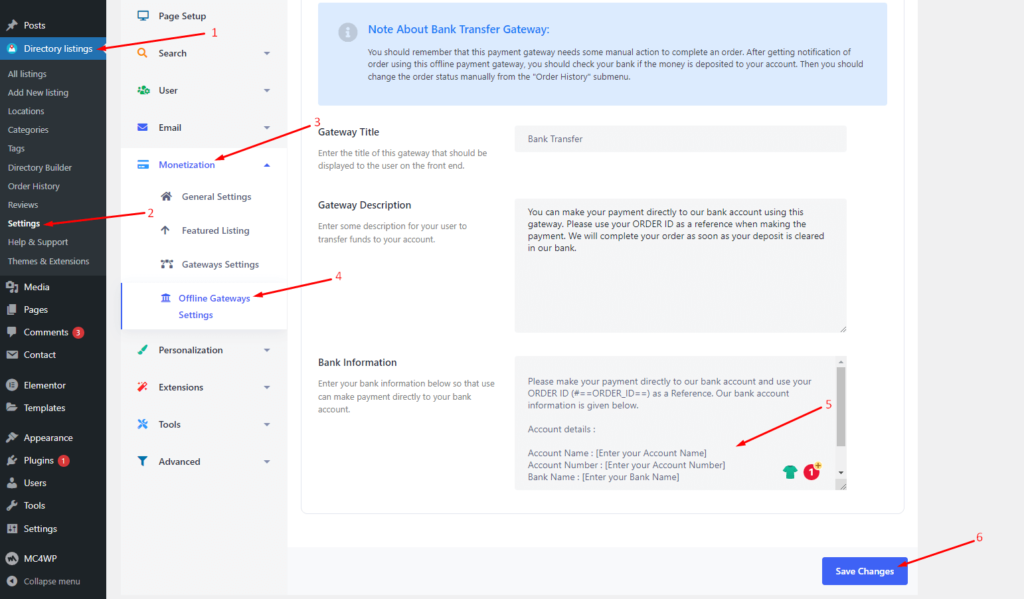
Note about Bank Transfer Gateway:
- You should remember that this payment gateway needs some manual action to complete an order. After getting a notification of an order using this offline payment gateway, you should check your bank if the money is deposited into your account. Then you should change the order status manually from the “Order History” submenu.
- Apart from the offline Bank transfer method, Directorist also supports online payments gateways like Stripe, PayPal, and Authorize.net. However, they are available in the premium version only.
Related Post: How to Add Payment Gateways to Monetize Your Directory Website
Step 5: Launch and Grow
Before launch, test:
- Property search
- Listing submission
- Contact forms
- Payment flow (if enabled)
Fix issues early to avoid user frustration.
Bonus Tips
- Free Elementor Support: Directorist ships with multiple widgets and is fully compatible with Elementor. If you use the dReadestate theme, you will get a section called “Theme Elements” in the Elementor editor panel. This section contains some important widgets such as Section Title, Contact Info, All Listings, and Search Form. Let’s enter the “Search Form” from it:
However, you can also insert and customize the ‘Search bar’ from the Directorist widgets like any other Elementor widgets.
Just like the Theme Elements of OneListing theme, you can effortlessly edit the Directorist widgets too. For instance, you can control whether to show the pagination or not, select the width of the container, etc.
- Free Gutenberg Support: You can also generate the Directorist pages using the Gutenberg block editor. This makes the tool even more useful as the WordPress ecosystem is gradually adapting to the Gutenberg block editor instead of the page builders. Directorist currently has16 Gutenberg blocks. For example, let’s generate the “All Listings” page in Gutenberg block editor using Directorist blocks:
SEO Optimization
Search traffic is critical for real estate sites.
Focus on:
- Location-based keywords
- Optimized listing pages
- Clean URLs
- Fast loading speed
Recommended guide: How to Do SEO for Directory Websites
Promote Your Directory
Start promoting through:
- Social media
- Local real estate groups
- Content marketing
- Location-based blog posts
For inspiration, check: Real Estate Directory Examples
Wrapping up
With a powerful WordPress directory plugin like Directorist, you can build a real estate directory fast and with great control. The free version offers some features that are often sold as premium ones in some other directory tools. We can guarantee that you won’t regret using this amazing directory builder tool.
If that sounds interesting, you can try out the demo version to get a hand on experience before you start downloading and using the plugin forever. You will get the demo link below.
We hope this tutorial will properly and efficiently guide you to build your real estate directory. In case you are stuck with one of the steps mentioned above, don’t hesitate to drop us a line below. We will take it seriously and someone from us will reply to your query. if you are already using Directorist, don’t forget to share your thoughts in the comment section.
For regualr updates, you can follow Directorist on Facebook, Twitter, and LinkedIn! You can also join the Directorist Community for sharing your thoughts and experiences relating to the directory niche. Come and join us to see what we’re up to.

Editorial Staff
Directorist Editorial Staff is a team of WordPress geeks that provides quality content for WordPress users. Primarily the team works for all the ingredients needed for establishing a directory listing website in WordPress. Moreover, you will get numerous web content related to the WordPress blog, Digital marketing stuff, social post, text documentation, visual guides, and so on.
Related Articles


2 Comments
Leave a Reply
You must be logged in to post a comment.
Quester
September 21, 2022Hi Al Suzaud Dowla,
How much you charge to build one Property Directory Website?
Thanks
Mahdi
October 2, 2022Hi @Quester,
We do not have any website-building services. However, with our VIP Membership plan, we provide you with the Installation and Setup service along with many other perks. More here: https://directorist.com/pricing/#:~:text=Renewal%20not%20required-,Directorist%20VIP,-Save%2030%25